
Poor fetal growth is one of the most serious problems in pregnancy. A growth scan can ensure that the growth has been normal and that the placental and baby circulation is normal. KYPROS Scan will assess the blood flow to and from the placenta using a Doppler test.
What does the Fetal growth and Doppler scan involve?
The scan usually takes about 20 minutes, although it can occasionally take longer. The scan will look at the baby’s size by measuring the head, abdominal girth and the length of the thigh bone. The amount of water around the baby will be measured. The Doppler scan will look into the blood flow in various vessels in the baby’s body and in the umbilical cord. The baby’s weight will be estimated. We will give you 3D and 4D views of the baby’s face if you wish.
You will get a report immediately after the scan and you will have the opportunity to ask any questions.
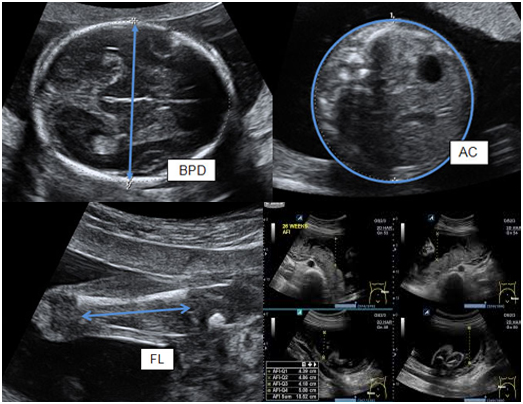
Fetal Well Being Scan/Growth Scan
The growth scan, sometimes called the wellbeing scan or positioning scan, takes place when the mother is between 23 and 40 weeks pregnant. It checks how well the baby is growing and the position in the uterus (womb).
During the scan the doctor:
Why is a growth scan required?
If the baby has an average head size, but a big abdomen, he/she may just be getting a good food supply from the placenta. If the mother has diabetes in pregnancy (gestational diabetes) she may have a big baby (macrosomia). This happens when the mother’s blood sugar levels have risen too high. This can make the baby measure larger than expected for all parameters.
If the baby has an average head size and a small abdomen,, this may simply indicate a small, healthy baby. Occasionally, though, this can be a sign that the baby is not growing properly. The scan may also show that the amount of amniotic fluid is low. The two sometimes occur together.
If the baby is smaller than expected, he/she may have a low birth weight. To find out why the baby is small, the doctor might ask for a Doppler scan.
Scans are usually accurate for assessing the baby’s size in the first half of the pregnancy. By the time the mother is in the later stages of pregnancy, scans continue to be accurate, as long as the baby is small or of average size. The closer it gets to the due date, and the bigger the baby is, the harder it will be to record measurements.
The baby’s head may be too low in the pelvis in late pregnancy to get a measurement. Even if the baby’s abdomen can be measured, it’s very difficult to take other factors into account, such as how long the baby is.
Why is a scan even needed in the third trimester?
The most common reason for a scan in the third trimester is to check that the baby is growing normally. The mother will be offered a growth and fetal wellbeing scan between 28 weeks and 32 weeks of pregnancy. This will show the doctor how the baby is growing.
The mother will get another growth scan and colour Doppler studies closer to thedue date (if required), between 36 and 40 weeks to:
The mother might get additional scans in thethird trimester if:
What can third trimester scans detect?
The third trimester scans will look at the following:
The baby’s wellbeing
This is measured by his biophysical profile. A healthy baby:
The doctor will observe the baby doing all these activities on the scan.
The doctor will observe the baby doing all these activities on the scan.
What happens during a fetal growth scan?
During the fetal growth scan, various measurements are taken of the fetus. The measurements are plotted on a growth chart, according to the number of weeks pregnant that the patient is at the time of the scan (gestational age).The main fetal measurements taken for a growth scan include:
Monday to Friday 9.00 am to 8.00 pm
Saturday & Sunday 10.00 am to 5.00 pm
11/47F/21, Vengateshapuram, near star saw mill, Sungu Pettai, Perambalur, Tamil Nadu 621212
Copyright 2024 © All Right Reserved, Designed by Oxygen